TWO:The folly of Ripperda, however, had ruined his credit with his own sovereigns and the nation even more than with foreign Powers. His swaggering and inflated language, in which he imagined that he was enacting Alberoni, had destroyed all faith in him. But his final blow came from his own false representations to each other of the preparations for war made by Austria and Spain. Count K?nigseck was most indignant when he discovered the miserable resources of the Spanish monarchy in comparison with the pompous descriptions made of them by Ripperda at Vienna; and the Spanish Court was equally disappointed by a discovery of the real military status of Austria. Ripperda was suddenly and ignominiously dismissed on the 14th of May.
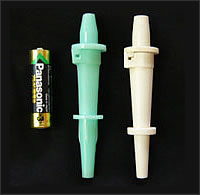
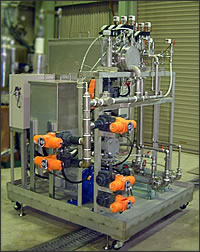
A hydrocyclone (liquid cyclone) injects treatment solution into stationary equipment to perform separation, classification, and concentration, and is an innovative separator with a very simple structure and no drive unit.
Structure of a hydrocyclone (liquid cyclone)
A suspension containing fine particles of several micrometers or more is supplied to a cylindrical container circumferentially at high speed. And as a result it starts to rotate and a centrifugal force is generated. At this time a gravitational acceleration of several tens of thousands of G is generated in the circumferential direction, and thus leading to fast sedimentation and concentration of the fine particles. The separated concentration can be freely selected by changing the supply rate (supply pressure and flow rate) and the flow ratio of the outlet. Our hydrocyclone (liquid cyclone) was designed and manufactured to classify and concentrate fine particles, and so has a small element.
THREE:Scarcely had Parliament ceased to sit, and the king was gone to spend the summer months in Germany, when the vigilance of the Ministry was demanded to ward off a fresh invasion. Alberoni, defeated in his schemes on France, and his hopes of the invasion of England by Charles XII. crushed by that monarch's death, determined now to make a grand effort to support the Pretender himself. For this purpose, he invited him to Spain, and at the same time began the equipment of a formidable fleet to carry over a Spanish force, under the command of the Duke of Ormonde, to the shores of Britain. The Pretender was not intended to accompany the expedition, but to be in readiness to follow on the first news of its[43] successful landing. But it was no more destined to reach these shores than the Grand Armada. It has always been the fate of invading squadrons to encounter providential tempests in coming hitherward, and the usual hurricane was ready to burst. Scarcely, indeed, had the fleet lost sight of Cape Finisterre before the storm swooped down upon it. For twelve days the terrible Bay of Biscay was swept by a frightful wind, which drove the vessels in all directions, and rendered it impossible to manage them. Fortunate would it have been if every vessel had failed to reach the shores at which they aimed; but two vessels, on board of which were the Earls Marshal and Seaforth, and the Marquis of Tullibardine, accompanied by about three hundred Spanish soldiers, reached Scotland, and landed, on the 16th of April, at Kintail, in Ross-shire. In the hope that Ormonde would still reach England, this small force lay quiet for some time, and so little did they excite notice, that the Government imagined that they had re-embarked. Their presence there, however, had the mischievous effect of exciting some few of the Highlanders to join them. They seized Donan Castle, and thus attracted the attention of the English. Some vessels of war arrived upon the coast. The castle was speedily retaken, and Lord Carpenter, the commander of the forces in Scotland, sent some troops from Inverness against them. General Wightman, the officer thus despatched, was attended by about a thousand men, and found the enemy, now swollen to about two thousand, strongly posted at Glenshiel. He immediately attacked them, and the miscellaneous force speedily dispersed. The Highlanders, who knew the country, rapidly disappeared amongst the hills, and the Spaniards had no other resource than to lay down their arms.These occurrences in Ireland led to hostile demonstrations against the Government in Parliament. On the 7th of March Mr. Shaw, the Recorder of Dublin, as the representative of the Irish Protestants, commenced the campaign by moving for returns of the number of committals, convictions, inquests, rewards, and advertisements for the discovery of offenders in Ireland from 1835 to 1839, in order to enable the House to form a judgment with regard to the actual amount and increase of crime in that country. The debate was adjourned till the following Monday, when it was resumed by Mr. Lefroy, after which the House was counted out, and the question dropped; but it was taken up in the Lords on the 21st of March, when Lord Roden moved for a select Committee of inquiry on the state of Ireland since 1835, with respect to the commission of crime. His speech was a repetition of the usual charges, and the debate is chiefly worthy of notice on account of the elaborate defence by Lord Normanby of his Irish administration. "I am fully aware," said the noble marquis, "of the awful responsibility that would lie upon my head if these charges rested upon evidence at all commensurate with the vehemence of language and earnestness of manner with which they have been brought forward; but they rest upon no such foundation. I am ready, with natural indignation, to prove now, on the floor of this House, that I have grappled with crime wherever I have found it, firmly and unremittingly, and have yielded to none of my predecessors in the successful vindication of the laws." Among the mass of proofs adduced by Lord Normanby, he quoted a vast number of judges' charges, delivered from time to time between 1816 and 1835, which presented only one continuously gloomy picture of the prevailing practice of violence and atrocious outrage. Passing from this melancholy record, he proceeded to refer to numerous addresses of judges delivered on similar occasions since 1835. All of these contained one common topic of congratulation¡ªthe comparative lightness of the calendar¡ªa circumstance, the noble marquis argued, which went far to establish his position, however it might fail to prove the extinction of exceptional cases of heinous crime. With regard to the wholesale liberation of prisoners, Lord Normanby distinctly denied that he had set free any persons detained for serious offences without due inquiry; or that any persons were liberated, merely because he happened to pass through the town, who would not have met with the same indulgence upon facts stated in memorials. "No; this measure," he insisted, "had been adopted upon the conviction that, in the peculiar case of Ireland, after severity had been so often tried, mercy was well worth the experiment. It was one which was not lightly to be repeated; but while he had received satisfactory evidence of the success of the measure, it was in his power to produce the testimony of judges with whom he had no political relations, to the pains taken in the examination of each case, and the deference shown to their reports."
- Equipment costs can be reduced.
- Operating costs can be reduced.
- Maintenance costs can be reduced.
- Any change in raw material and product can be easily addressed.
- Large amounts can be treated in a small area.
- Separation and cleaning are easy because of the simple structure.
- Simplified control
- This equipment can be operated in synchronization with external devices.
- Alarm and interlock mechanism.
THREE:The number of places in which the inquiries under the commission were carried on was 237, having a population of 2,028,513. In twenty-five places the number of corporators was not ascertained; in the others (212) they amounted to 88,509. The governing body was self-elected in 186 boroughs. This body elected the mayor in 131 boroughs, appointed the recorder in 136, and the town-clerk in 135. The number of corporators exercising magisterial functions was 1,086, in 188 boroughs. In 112 boroughs the corporations had exclusive criminal jurisdiction, extending to the trial of various descriptions of offences, and in forty-two their jurisdiction was not exclusive. Seventeen boroughs did not enjoy any income whatever; in eight the precise amount could not be obtained. The total income of 212 boroughs amounted to ¡ê366,948; their expenditure to ¡ê377,027. 103 were involved in debts amounting to ¡ê1,855,371, and were besides burdened with annuities amounting to ¡ê4,463. In twenty-eight boroughs only were the accounts published; in fifteen the annual income was under ¡ê20; in eleven it was between ¡ê2,000 and ¡ê3,000; in five, ¡ê3,000, and under ¡ê4,000; in one, ¡ê4,000, and under ¡ê5,000; in four, ¡ê5,000, and under ¡ê7,500; in five, ¡ê10,000, and under ¡ê12,500; in one, ¡ê12,500, and under ¡ê15,000; in one, ¡ê15,000, and under ¡ê20,000; and in one, ¡ê91,000.
- Classification and concentration for the manufacture of inorganic powder materials
- Classification of ceramic materials
- Removal of fine particles, including iron powder
- Removal of fine particles from pigments
- Removal of fine organic particles from solvents
- Separation of starch and yeast
- Removal of fine particles from high-temperature strong acid solutions
- Removal of fine particles from low-temperature solutions